
Bottom left to right: Aparna Bhaduri, PhD; Matt State, PhD; Alice Ting, PhD; Trey Ideker, PhD; Willow Coyote-Maestas, PhD
As outlined in Proposition 14, one of the goals of the California Institute for Regenerative Medicine (CIRM) is to help accelerate discoveries that enhance our understanding of central nervous system (CNS) disorders. As part of this goal, CIRM launched the Research using Multidisciplinary, Innovative approaches in Neuro Diseases (ReMIND) Program in 2023 with the ReMIND-L (DISC4) awards.
Through the 2024 ReMIND-L awards, CIRM is supporting large, collaborative research teams conducting expansive, integrated research projects, utilizing recent advancements in stem cell and genetic research, to address critical gaps in the study of neuropsychiatric disorders, including schizophrenia, bipolar disorder, autism spectrum disorder, and other conditions that significantly affect patients and caregivers throughout California.
Tomasz Nowakowski, PhD, of UC San Francisco’s Eli and Edythe Broad Center of Regenerative Medicine and Stem Cell Research is the principal investigator for one of the awarded teams which aims to uncover how genetic mutations associated with schizophrenia can impact protein function and brain development.
Dr. Nowakowski and his co-investigators Alice Ting, PhD, of Stanford; Nevan Krogan, PhD, and Willow Coyote-Maestas, PhD, of UCSF; Aparna Bhaduri, PhD, of UCLA; Matthew State, PhD, of the Langley Porter Psychiatric Institute; and Trey Ideker, PhD, of UC San Diego will be using stem cell technologies and AI-driven models to identify the biochemical processes underlying these mutations and create public resources that will be used to advance understanding and treatment of neuropsychiatric disorders.
Some responses have been edited for clarity and brevity:
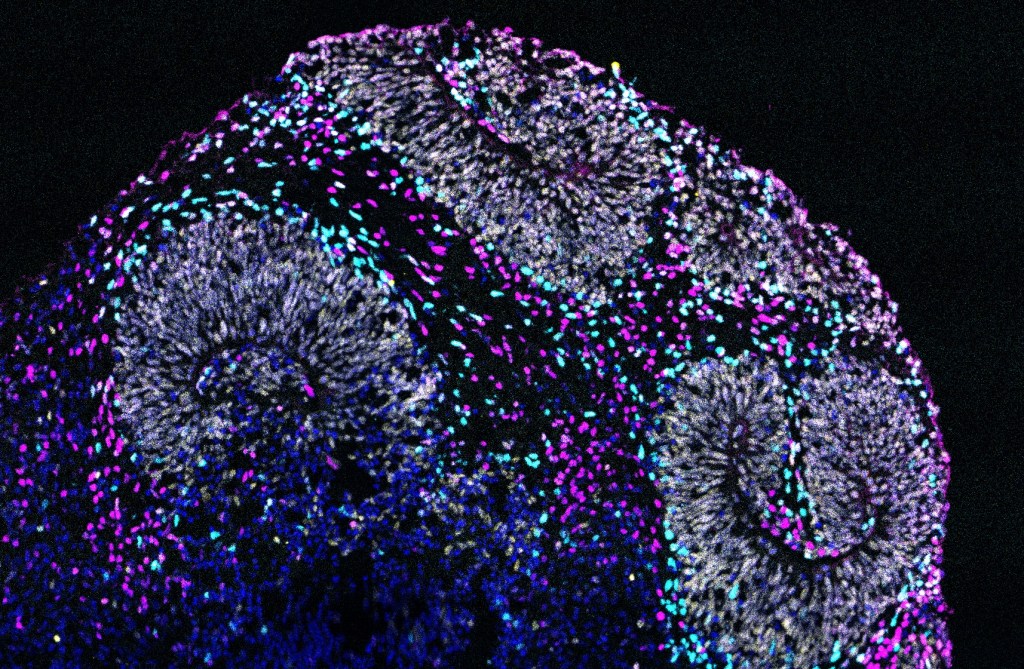
CIRM: Please share a summary of your research project. Is there a particular disease focus? Is there a broader question that this project is hoping to address?
Dr. Nowakowski: This project seeks to advance our understanding of how mutations in genes causally linked to schizophrenia diagnosis impact protein structure and function, as well as human brain development. We will leverage stem cell technologies to create research resources and foundational datasets. We will harness advances in artificial intelligence to develop computational models that use a biologically informed approach for predicting the risk of severe neuropsychiatric phenotypes from genetic variants identified through genome and exome sequencing, establishing a public resource of variant-to-function relationships in schizophrenia.
CIRM: What are some of the discoveries you’re hoping to achieve through this research project? What are some research challenges you’d like to overcome through this project?
Dr. Nowakowski: Although hundreds of genetic mutations have been now identified among patients with neurodevelopmental disorders and schizophrenia, it is unclear how these variants lead to neuropsychiatric symptoms.
We have decided to focus our efforts on proteins, which are encoded by genes and disrupted by mutations, as biological ‘mediators’ of genetic risk. By studying how genetic mutations affect protein structure, function, localization, and interactions, we hope to pinpoint biochemical processes that could present new drug targets for these disorders.
We are also excited to work with researchers who develop new technologies that will allow us to probe deeper into the inner workings of the brain to better understand how and why neurodevelopmental disorders and schizophrenia arise in the first place.
CIRM: What are some ways this research project can positively impact patients across California and the world? Alternatively, what are the ways in which this research could change the way this disease is considered or studied by other scientists?
Dr. Nowakowski: There is a growing number of neuropsychiatric patients who are diagnosed with genetic mutations, but currently very little of that information subsequently impacts treatment options. Fundamental studies of how these mutations affect protein structure and function has the potential to reveal novel targets for pharmacological intervention.
Our research has the potential to directly facilitate the development of precision interventions for these patients. Our team will develop new technologies to more easily study the effects of genetic mutations on protein structure, localization, and function. This is important, because proteins mediate the pathogenic effects of mutations, and their role has been vastly understudied. By taking advantage of emerging artificial intelligence models, our team seeks to accelerate our ability to predict the risk for neuropsychiatric symptoms from genetic data alone.
CIRM: In your words, can you share why research for neuropsychiatric disorders and diseases affecting the Central Nervous System (CNS) is so important?
Dr. Nowakowski: Neuropsychiatric disorders present a major source of socioeconomic burden in California. These conditions are highly heritable, and can result in significant social, communicative, cognitive, and behavioral challenges to individuals affected. In some cases they require lifelong medical support, and disproportionately affect disadvantaged communities. Neuropsychiatric disorders are especially difficult to predict, manage, and urgently require progress in novel therapeutic development.
CIRM: The ReMIND program is a pilot for collaborative, multi-investigator funding for foundational basic discovery research. Could you speak to the timeliness and impact of such funding structures more broadly and why you think such funding structures will be impactful for CIRM’s mission?
Dr. Nowakowski: By design, collaborative, multi-investigator projects provide a unique opportunity for researchers to pursue cross-disciplinary research that couldn’t be accomplished using traditional single investigator grants. This is important especially in studies of neurological and neuropsychiatric disorders, where the complexity of the conditions require experts in genetics, molecular biology, biochemistry, and bioinformatics working together on a focused problem.
A well-designed multi-investigator collaboration can achieve a lot more than individual labs could ever hope to accomplish by themselves. It ensures that research findings are reproducible and create a coherent, integrated body of knowledge that is much better at identifying translational opportunities. CIRM’s support for multi-investigator collaborations will create an innovative research ecosystem that is far more likely to lead to translational projects than traditional research initiatives.
CIRM: CIRM is celebrating its 20-year anniversary this year. In your words, can you describe CIRM’s impact over the last 20 years?
Dr. Nowakowski: CIRM has had an outsized impact on research in California over the past 20 years by creating a cutting-edge research environment, particularly through investments in infrastructure and training programs across California that created opportunities for many to become involved in stem cell research.
I, myself, have chosen to come to California after completing PhD training abroad to take advantage of this exciting opportunity as a postdoctoral scholar. I participated in CIRM-funded projects such as the CIRM Center of Excellence in Stem Cell Genomics (CESCG), which has been truly transformative for my career. Collaborations initiated through these opportunities have led to some of the most exciting discoveries of my research so far and launched lasting research partnerships that help me advance research into the causes of neuropsychiatric disorders.
Learn more about the ReMIND program at cirm.ca.gov/remind.
 The Stem Cellar
Pingback: 🧬 Science, Secrets & The Legacy of Medical PioneersSuggestEdit - The Contemporary Polymath