 |
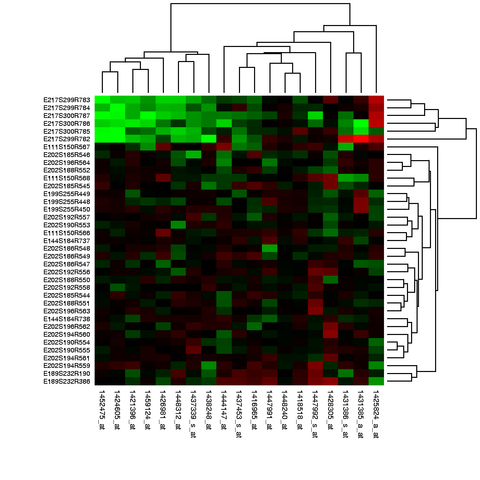
| Jeanne Loring generates gene expression maps similar to this one to help stem cell scientists determine if their iPS cells are truly pluripotent, that is; they can form any cell type in the body (image: wikimedia commons, Miguel Andrade) |
I don’t think our grantee from the Scripps Institute, Jeanne Loring, would mind me referring to her as a stem cell wonk. She has been in the field longer than the vast majority of folks in the community, and has spent much of that time doing fundamental work trying to define the various types of cells and ways to tell them apart.
Although she now has some work that is close to the clinic, most of her work that is well known in the field involves looking at some of the most boring and repetitive tasks in the field and figuring out how these steps that are needed to verify accuracy can be done more efficiently, at less cost, and boring the post docs that have to perform them a little less. She presented a review of the work this afternoon on the second day of the annual meeting of the International Society for Stem Cell Research.
Anybody who has worked with pluripotent stem cells, those cells that can become any part of the body, has spent considerable time with what is known as the teratoma test. You can’t just look at a cell and determine if it is pluripotent. But because it can form many different tissues, if you transplant them in just the right spot in a mouse, they will form a tumor called a teratoma, which has clearly discernable tissue composed of many parts of the body, often even early stage teeth. Because of the animal model, this eats time, money, and human resources that could be doing more interesting research.
Researchers have known that some genes that are turned on in pluripotent cells are turned off in adult cells, and vice versa. So, her team looked at the genes being expressed in 400 stem cell lines, both embryonic stem cells and reprogrammed, so called iPS cells. That type of test, called a gene expression analysis, creates a very visual graph of what genes are active. She has turned that into an online computer program that allows researchers anywhere to submit gene expression maps of their cells and get a rapid response about whether they are truly pluripotent.
After her presentation, one of the questions from the audience started with a thank you to Jeanne. “Having these available is incredibly valuable to the community.” She did much of this work using a grant from CIRM, but it can now accelerate the work in labs around the world. To give Jeanne her due, she is more than just a wonk developing tools. In these two very short videos, she describes two of her projects that are working toward clinical trials, one in Parkinson’s disease, and one in Multiple Sclerosis. But you can bet she used her short cut tools to move these projects along.
 The Stem Cellar
I love it! Thanks!