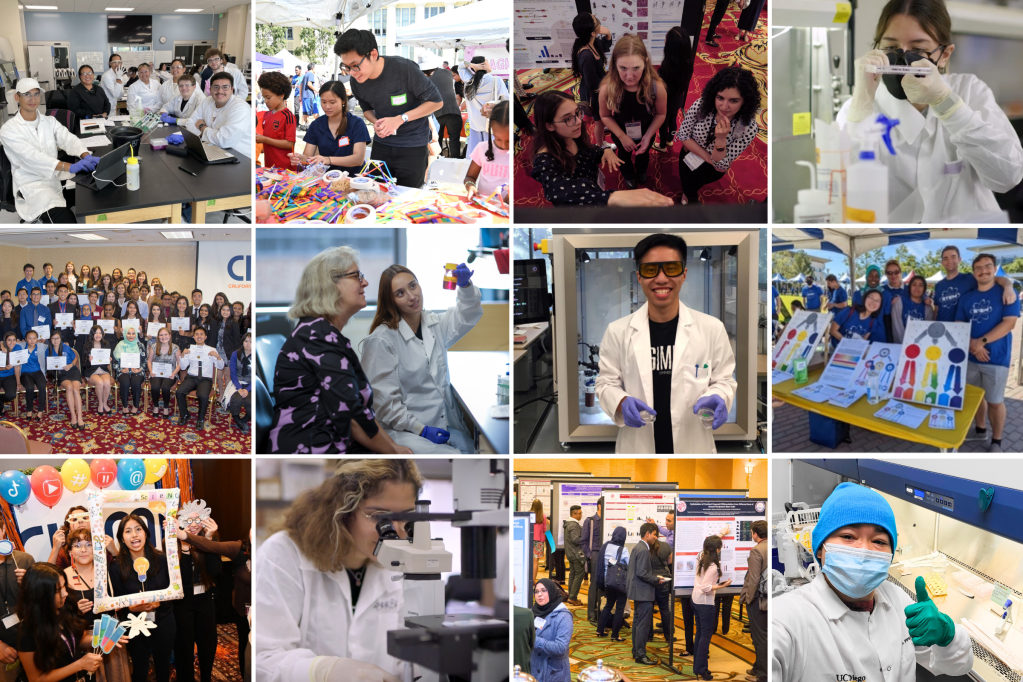
In celebration of the California Institute for Regenerative Medicine (CIRM)’s 20th anniversary, we have been reflecting on some of the early projects we supported and their outcomes.
Today, we’re looking at our first set of grants, which we awarded in 2006 to support training programs for graduate students and postdoctoral fellows. Not long after, CIRM began launching programs to train bright high school, undergraduate, and master’s level students who don’t otherwise have access to high-tech biomedical research equipment and experiences. These programs, and the ones we’ve launched since, created a pipeline to bring the best students from across the state into the regenerative medicine workforce. To date, CIRM has committed $447,419,036 to education programs.
This emphasis on education is helping build the biotechnology workforce that’s needed to generate new cures. Any time a new therapy reaches patients, it’s because of all the MDs and PhDs leading research and clinical programs, the graduate students, postdoctoral students, research associates, lab techs, and interns working in those labs, and a whole host of technicians and others who got the training needed to translate new discoveries into therapies. Bright young students without the right training are locked out of these jobs that are critical for developing new therapies.
If California is going to lead in developing cures, we also need to lead in training the people who are going to make those cures a reality.
“We are incredibly proud of our programs that train talented young people from across the state to become eligible for high paying jobs in the regenerative medicine field,” said Kelly Shepard, Director of Discovery and Education at CIRM. “These students are our future.”
According to the California Governor’s Office of Business and Economic Development (GO-Biz) the state’s life sciences industry directly employs 466,888 workers and generates over $414 billion in annual economic output. Also, more bioscience and biotechnology patents are issued to companies and researchers in California than in any other state. Obviously, CIRM didn’t participate in creating or filling all of those jobs, but it’s no accident that the state leading in biotechnology was the first to directly fund biomedical research.
CIRM currently has four internship and training programs—SPARK, Bridges, COMPASS, and Scholars—that each support the next generation of regenerative medicine scientists, ranging from high school and undergrad students to doctoral candidates and clinical fellows. Each program helps students build the technical skills that are crucial for present and future scientific and medical advancements.
You can read more on our blog about some of the more than 4,600 trainees who have participated in these programs.
 The Stem Cellar
Pingback: Jeffrey Randall Allen Champions CTD Research to Help His Son