
Over the past 20 years, the California Institute for Regenerative Medicine (CIRM) has supercharged research in California in ways that have often filled gaps in federal research funding. This has been true since CIRM was founded in 2004, and federal funding for embryonic stem cell research was extremely hard to come by.
Now, given current federal research budget cuts, CIRM is continuing to prioritize critical research in California that might otherwise stall. And to be clear, when research stalls, so do new therapies.
A few different factors are limiting biomedical research funding across the United States. In addition to recent NIH funding cuts that are harming research areas broadly, the 2016 21st Century Cures Act is also set to expire in 2026. Since 2017, the Cures Act has supplemented NIH funding to critical programs, including the BRAIN Initiative – an initiative within the National Institutes of Health that focuses on the development and application of innovative technologies to produce a new, dynamic picture of the brain. Overall funding for the BRAIN initiative has declined since a peak in 2023, primarily due to planned decreases in allocations from the Cures Act.
A chart on the BRAIN Initiative website illustrates this budget shift, showing that the 2025 total budget is the lowest since 2018:
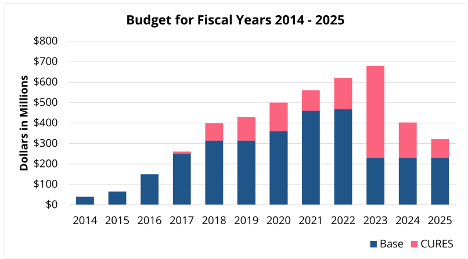
The sharp downward trend in BRAIN Initiative funding means less research on spinal cord injury, Parkinson’s disease, Alzheimer’s disease, epilepsy, stroke, and so many other conditions with no effective therapies.
CIRM’s investment in neuroscience research
The funding decline for federal BRAIN Initiative projects comes at a time when CIRM is implementing a new strategic plan calling for significant funding for neuroscience research in California. When Proposition 14 passed in 2020 and allocated an additional $5.5 billion to CIRM, it explicitly called for $1.5 billion to be set aside for diseases of the central nervous system.
One investment from CIRM in neuroscience research is the ReMIND (Research using Multidisciplinary, Innovative Approaches in Neuro Diseases) program, which awarded $83 million to seven collaborative teams across California to advance basic research in neuropsychiatric diseases. You can read more about projects funded in the ReMIND 2024 funding round.
In announcing the ReMIND program, Rosa Canet-Avilés, PhD, Chief Science Officer at CIRM, said, “Effective treatments for neuropsychiatric diseases remain a significant unmet medical need in California, the U.S., and the world. The ReMIND program is part of a deliberate drive at CIRM to support multidisciplinary discovery research as a way to catalyze innovation, especially in areas of large potential impact.”
In March 2025, CIRM’s governing board approved the DISC4 Awards program, which builds upon the framework of the ReMIND program to support cross-disciplinary collaborative projects more broadly. The 2025-2026 DISC4 Awards will continue to prioritize research in diseases of the brain and central nervous system, with an initial commitment of $84 million, extending CIRM’s continued impact in foundational neuroscience projects.
In addition to these new programs, CIRM has a strong history of funding neuroscience research across discovery, translational, and clinical stages. As of January 2025, CIRM has awarded more than $400 million in discovery research across multiple neurological categories. At the translational and clinical stages combined, CIRM has invested an additional $675 million to accelerate promising discoveries toward clinical trials and advance therapies toward patient use. These significant investments help fill critical gaps left by declining federal research budgets.
To explore our grants, including neuro-related awards, please see the CIRM Grants Dashboard.
 The Stem Cellar
Thank you for the update. In these research-challenged times it’s great to see that $11,507,004.79 has been dedicated to research related to Multiple Sclerosis. I look forward to additional funding dedicated to this important area. The National Multiple Sclerosis Society has funded $101M for 240 projects related to their Pathways to Cures initiative. Collaboration and addition stem cell research funding can help us learn more about this chronic neurological disease and hopefully restore lost function for those affected. With $1.5B authorized for neurological research, now’s the time to fill the gap.
Thank you,
James Stewart