This summer we’re sponsoring high school interns in stem cell labs throughout California. We asked those students to contribute to our Instagram photos and YouTube videos about life in the lab, and write about their experiences.
Ray Solis worked in the lab of Nicholas Schork at Scripps Research Institute.
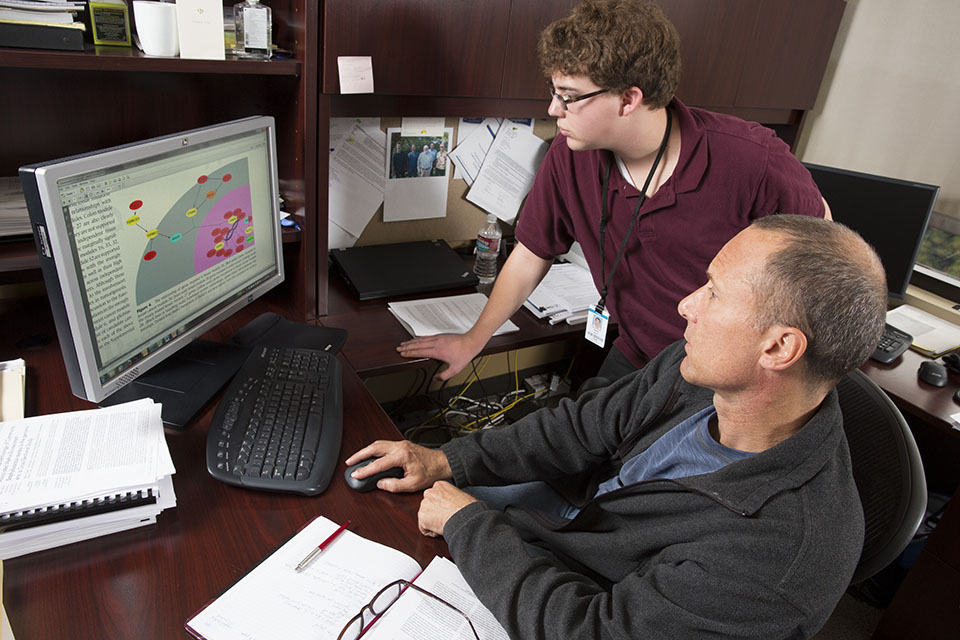 |
| Ray Solis working with his mentor. He submitted this image through Instagram to CIRMs #CIRMStemCellLab collection. |
During the summer of 2013, I had the incredible opportunity to participate in a full time internship in the lab of Dr. Nicholas Schork at the Scripps Translational Science Institute, which is part of The Scripps Research Institute. During my internship, I personally worked alongside Dr. Schork on a very fascinating multidisciplinary stem cell research project. For my project, I designed and developed a unique, one-of-a-kind prototype database that consolidated high quality datasets, research and data analysis tools, articles and information about the current research being conducted on human induced pluripotent stem cells. To do this, I utilized and conducted a thorough analysis of multiple sources such as PubMed, Google Scholar, Gene Expression Omnibus, and other online resources.
In addition to engineering this prototype database, I showcased its utility by conducting a research and data analysis project on the current studies of various diseases and the intervention of induced pluripotent stem cells as a method to develop potential therapies and cures for these diseases. I analyzed the gene expression of these diseases and drew conclusions about potential therapies and diagnostic methods. These diseases can result from numerous factors, which in many cases are beyond the patient’s control. Biomedical researchers are currently investigating various diseases and the role of genetics within them in hopes of introducing clinical cures. Research of induced pluripotent stem cells is widely conducted due to their incredible potential in developing personalized medicine. Many scientists have a particular interest in these cells because they can be derived from the patient’s skin, therefore allowing them to analyze the genetic information of the individual and personalize their care.
By creating a prototype database, I am providing the scientific community around the world with instant access to the information they are looking for, as well as access to tools and methods they can use to analyze the information in the public domain, as well as data that is generated within their lab. Over time, my database will grow and evolve and eventually go live for public use. As time has progressed, we have been swimming in information and continue to be presented with new findings and data. My database provides everything a scientist needs in one convenient location and provides them with a “one stop shopping” research experience. My analysis on the genetic expression of various diseases will also contribute to the rapidly advancing world of biomedical and stem cell research. I will be analyzing the relationships between the genetic expression of diseased samples and comparing the genetic expression of induced pluripotent stem cells that have been generated as a potential therapy for those diseases. This will provide insight to potential cures for some of the most common and life-threatening conditions in existence.
This internship has provided me with an invaluable opportunity to obtain real lab research experience and gain exposure, skills, knowledge, and contacts in my field of interest that I plan to pursue in the future. The prospect of stem cells being used as a therapy for diseases has always fascinated me and made me want to pursue science further. The idea of finding therapies and cures for diseases and contributing to the betterment of human health is truly what drives me to learn as much as I can about the world of scientific research. I have gained an enormous amount of knowledge about stem cells and their potential, uses, and the experiments and trials that are being conducted to further their path to clinical use. I am extraordinarily grateful to have this amazing opportunity that will help me to achieve my goals in life and lead me to more great opportunities and experiences.
Ray Solis
Ray submitted this video about his experience:
 The Stem Cellar
America's 50 worst charities rake in nearly $1 billion for corporate fundraisers
Every year, Kids Wish Network raises millions of dollars in donations in the name of dying children and their families.
Every year, it spends less than 3 cents on the dollar helping kids.
Most of the rest gets diverted to enrich the charity's operators and the for-profit companies Kids Wish hires to drum up donations.
Using state and federal records, the Times and CIR identified nearly 6,000 charities that have chosen to pay for-profit companies to raise their donations.
These nonprofits adopt popular causes or mimic well-known charity names that fool donors. Then they rake in cash, year after year.
The nation's 50 worst charities have paid their solicitors nearly $1 billion over the past 10 years that could have gone to charitable works.
Until today, no one had tallied the cost of this parasitic segment of the nonprofit industry or traced the long history of its worst offenders.
To disguise the meager amount of money that reaches those in need, charities use accounting tricks and inflate the value of donated dollar-store cast-offs — snack cakes and air fresheners — that they give to dying cancer patients and homeless veterans.
Reaping the benefits
http://www.tampabay.com/topics/specials/worst-charities1.page
question every organization.
U.S. Probes Use of Antipsychotic Drugs on Children
Federal health officials are reviewing antipsychotic drug use on children in the Medicaid system. Federal health officials have launched a probe into the use of antipsychotic drugs on children in the Medicaid system, amid concern that the medications are being prescribed too often to treat behavioral problems in the very young.
The effort applies to a newer class of antipsychotic drugs known as “atypicals,” which include Abilify, the nation's No. 1 prescription drug by sales. The drugs were originally developed to treat psychoses such as schizophrenia, but some now have Food and Drug Administration approval for treatment of children with conditions such as bipolar disorder and irritability associated with autism.
In 2008, the most recent year for which complete data are available, Medicaid, the government health program for the poor, spent $3.6 billion on antipsychotic medications, up from $1.65 billion in 1999, according to Mathematica Policy Research, a Washington firm that crunches Medicaid data for HHS. The growth came even as pharmacy benefits for millions of Medicaid recipients shifted to Medicare in 2006.
Medicaid spends more on antipsychotics than on any other class of drugs. Abilify, made by Otsuka Pharmaceutical Co., appears on lists of the top 10 drugs paid for by Medicaid in various states.
Mark Duggan, a professor and health-policy expert at the University of Pennsylvania's Wharton School, says his analysis of 2010 data on five leading antipsychotics suggests that more than 70% of the cost of these drugs was paid for by Medicaid and other government programs.
http://online.wsj.com/article/SB10001424127887323477604578654130865747470.html
they know how to fund and make drugs available when they want to…..