 |
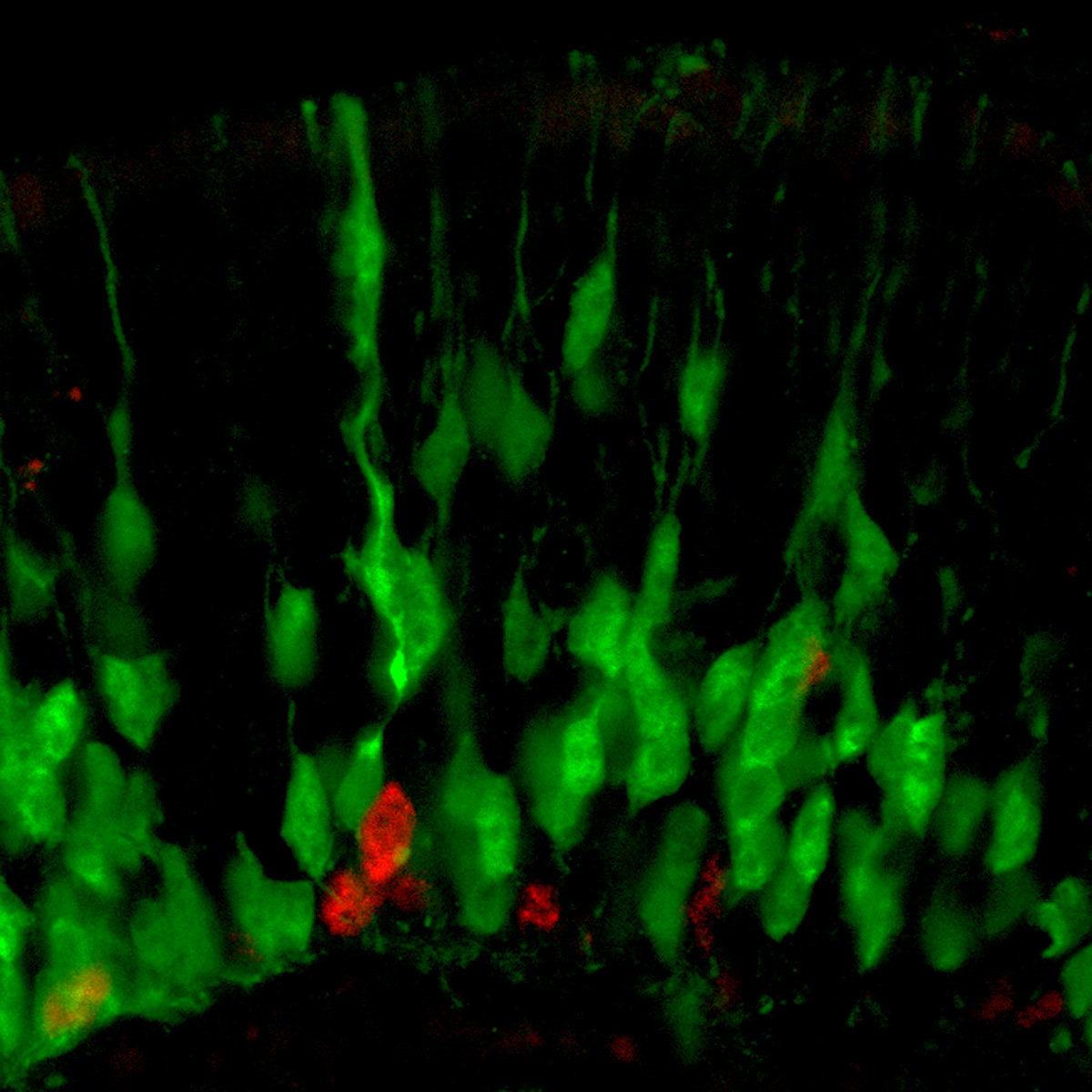
| Elongated green cells are sensory neurons – which sense smells and relay that information to the brain – that originated from olfactory stem cells in the nose. Cells labeled in red are immature cells in the process of differentiating into neurons and other mature cell types. (Photomicrograph by Russell Fletcher, UC Berkeley) |
A rose may smell as sweet by any name, but for those without a sense of smell a rose by any name still smells like cardboard. Now there’s a glimmer of hope for those whose fine wine and roses are odorless and who can’t taste. Researchers at the University of California, Berkeley have found a gene that’s responsible for prodding stem cells in the nose to form new odor-sensing neurons.
A press release by Robert Sanders at the UC Berkeley quotes lead researcher John Ngai talking about the loss of smell in old age:
“One reason may be that as a person ages, the olfactory stem cells age and are less able to replace mature cells, or maybe they are just depleted,” he said. “So, if we had a way to promote active stem cell self-renewal, we might be better able to replace these lost cells and maintain sensory function.”
The release goes on to quote Gary K. Beauchamp, director of the Monell Chemical Senses Center in Philadelphia, who was not a member of the research team. He noted that the olfactory system stands out for its ability to regenerate following injury or certain diseases.
The group found a gene that seemed to be involved regulating nasal stem cells. They created mice that lacked that gene and found that the mice had more than the usual number of odor-sensing cells. Sanders goes on to write about how regulating this gene — called p63 — could help people regain a sense of smell:
Any real world result of this work would be many years off — the path from a mouse lacking a gene to a drug that’s available to humans is a long and arduous one.
Neuron, December 8, 2011
CIRM Funding: Russell B. Fletcher, Melanie Prasol (T1-00007)
A.A.
 The Stem Cellar
The UK Stem Cell Bank in South Mimms is about to receive a deposit from Peter Braude's team at King's College London: human embryonic stem cells (hESCs) that are safe to use in medical applications. Best of all, researchers will be able to withdraw the cells for free.
The two new cell lines differ from all other known sources of hESCs because they have never been exposed to animal products, and so carry no risks of passing on animal diseases to patients.
“These are going in the bank for public benefit,” says Braude. His team has spent 10 years developing the “clinical grade” stem cells. “They're in the public domain for national and international use.” Industry may have to pay for the cells, though.
“Something should go back into the public pocket,” Braude says.
http://www.newscientist.com/article/mg21228423.000-embryonic-stem-cells-to-be-made-available-for-free.html