 |
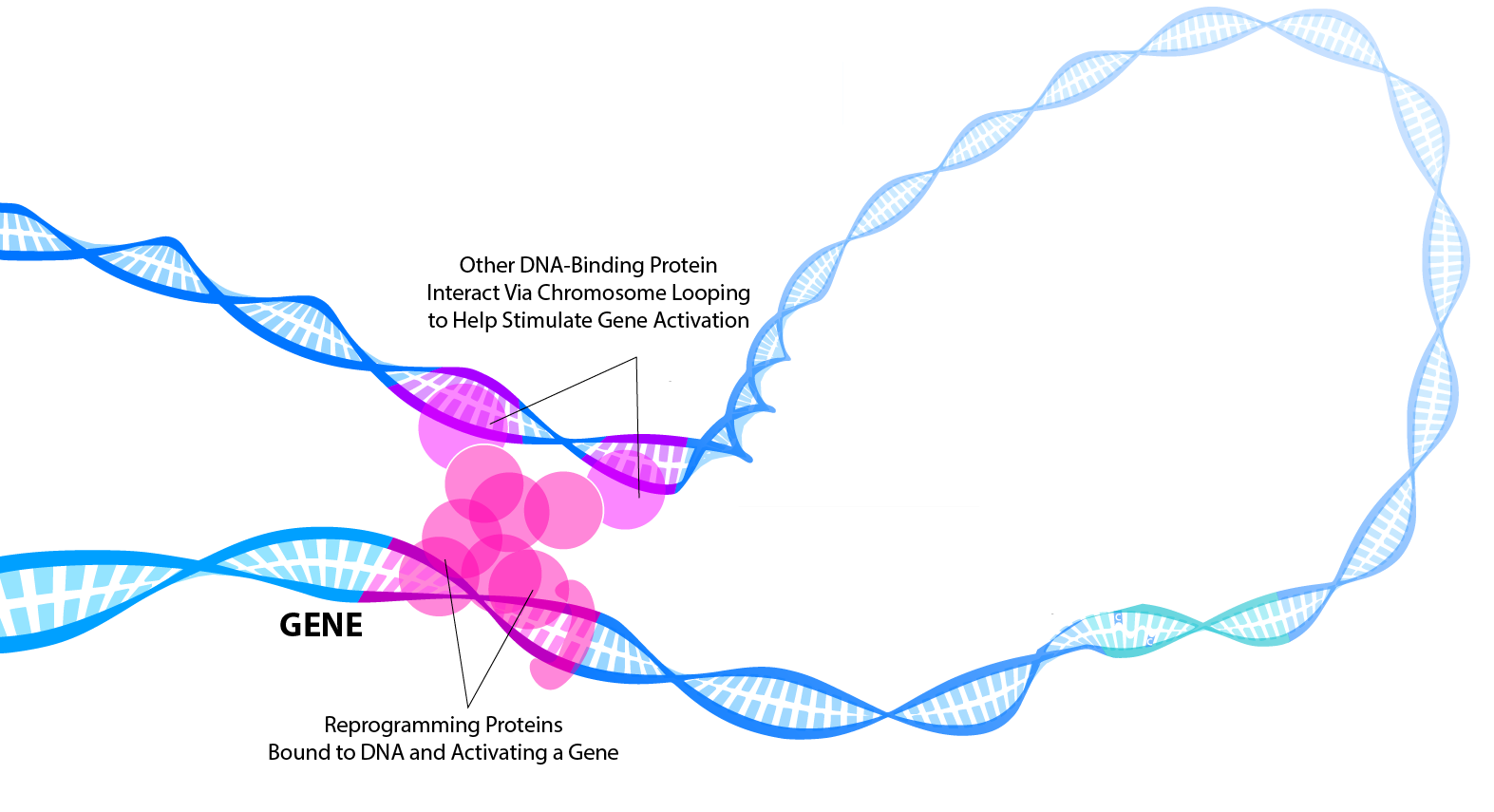
| A very simplified illustration of chromosomal DNA looping. This remodeling of the chromosome is essential for turning genes on and off (adapted from Kevin Song, Wikimedia Commons) |
Shinya Yamanaka’s 2012 Nobel Prize-winning technique of reprogramming adult cells such as skin, into embryonic stem cell-like induced pluripotent stem cells (iPSC) was a real breakthrough in the field. This innovation, first published in 2006, has led to the creation of patient-specific stem cells for drug screening, human “disease-in-a-dish” studies, and progress toward stem cell-based therapies. (read about an iPS-based CIRM Disease Team Grant as well as our numerous blogs about iPSC research).
And yet seven years after the initial breakthrough, reprogramming is still very inefficient: less than 99 percent of treated cells actually get reprogrammed into embryonic-like stem cells. Many researchers are trying to better understand what goes on inside cells during the reprogramming process to help increase this efficiency and ultimately help accelerate disease research. In today’s online publication of Cell Stem Cell, CIRM grantee Ji-Fan Hu and colleagues at Stanford report new results that suggest looping specific regions of chromosomal DNA is crucial to driving skin cells back toward an iPSC fate. The study was funded in part by a CIRM Tools and Technologies II grant.
The group started by asking: what’s the difference between cells that are able to convert to iPSC and those that don’t?
During the reprogramming process, scientists activate a handful of genes that act as master control switches: they produce proteins that bind to specific spots on the cell’s DNA. This DNA binding then activates a cascading set of genes that ultimately re-sets the skin cells’ properties to the stem cell-like state of iPSC. It turns out that those cascading events only happen if the string-like DNA loops around, bringing proteins bound to distant parts of the DNA together (see the simplified illustration above).
Hu and his colleagues showed that those loops were only present in the cells that did get reprogrammed. The other 99% that don’t get reprogrammed into stem cells lacked the DNA loops.
It turns out that a protein called SMC1 that is known to help chromosomal looping is plentiful in embryonic stem cells and iPSC but scarce in other cells. This points to SMC1 as a critical answer to the “to reprogram or not to reprogram?” question. And when SMC1 was removed from the skin cells, reprogramming into iPSC completely failed. The authors propose that since SMC1 is very low in skin cells, this looping may occur randomly in just a few skin cells which creates the right conditions for reprogramming to proceed.
Will this type of basic research directly point to a cure for, let’s say, Parkinson’s? Probably not. But these results could improve the efficiency of creating reprogrammed stem cells, giving scientists more time to work on new therapies rather than generating the cells they need to do the research.
T.D.
 The Stem Cellar