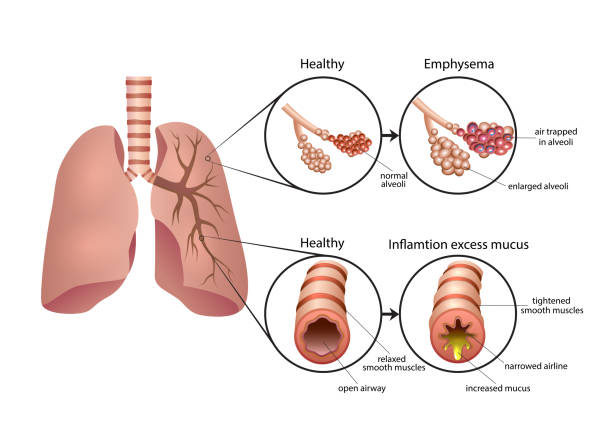
Emphysema damages the alveoli—the air sacs in the lungs. Their walls stretch and break down, making the lungs larger and harder to breathe. It is the most common form of COPD, typically caused by long‑term smoking, and affects an estimated 200 million people worldwide. There is no cure.
Endothelial
Researchers at Weill Cornell Medicine and NewYork‑Presbyterian found that specialized endothelial cells may help treat emphysema. Endothelial cells line blood vessels and help protect and restore organ function. In the lung, they line the blood vessel network surrounding the air sacs.
The team studied lung tissue from patients with emphysema and compared it with lung tissue from mice with an induced form of the disease. They found that changes in gene activity and loss of lung endothelial cells were linked to decreased lung function and emphysema progression.
Lung damage
Next, the researchers infused diseased mice with healthy lung endothelial cells from genetically identical animals. The results were striking: the treatment prevented or reversed most lung damage. By contrast, injecting other cell types—including endothelial cells from other tissues—had no therapeutic effect.
The team believes the benefit stems from differences in molecules secreted by healthy versus diseased lung endothelial cells. They found sharp increases in LRG1. LRG1 is a molecule tied to blood vessel growth and linked to retinal disease, kidney disease, and some cancers. They found this in endothelial cells from emphysematous human and mouse lungs. When they deleted the LRG1 gene in mice, the lungs were largely protected from emphysema damage, similar to the cell‑therapy effect.
In a Cornell news release,
“Taken together, our data strongly suggest the critical role of endothelial cell function in COPD/emphysema,” said co‑first author Dr. Alexandra Racanelli. “Targeting endothelial cell biology may represent powerful new strategies to treat advanced COPD or emphysema.”
The full study was published in the Journal of Experimental Medicine.

The increased of serum LRG1 levels are associated with various diseases, including different types of cancer, inflammatory bowel disease, joint disorders and cardiovascular diseases. Bone marrow derived cells serves as a major source of LRG1. The LRG1 is markedly induced in inflammatory stage of wound healing. The deletion of LRG1 causes impaired of immune cells infiltration, reepithelialization and angiogenesis resulting in substantial delay in wound closure. Therefore, LRG1 is required for normal wound healing but the excessive of LRG1 expression in diabetics is pathogenic and contributing to chronic wound formation. Thus, serum of patients with high levels of LRG1 is closely related to inflammatory, autoimmune and cardiovascular diseases.
Endothelial cell line is an inner part of vessel has important roles to maintain vascular homeostasis and regulate vascular tone, vessel permeability and leukocytes adhesion. The vascular homeostasis becoming breakdown, when endothelium cells (ECs) are activated by factors such as proinflammatory cytokines, hyperglycemia and pro-anthrogenic shear stress. However, dysfunctional of ECs is associated with development of atherosclerosis, a chronic inflammatory disease involves excessive net uptaktof low density lipoprotein(LDL). LRG1 is intimately linked to tissues inflammation. An increase of LRG1 expression is induced in activated ECs and endothelium of stenosed coronary arteries. The elevated uniaxial shear stress is relevant to arteries are already in stenotic. The different levels of LRG1expression in stenotic coronary arteries suggest a potential role of LRG1 evolved in vascular homeostasis and arterial disease. Therefore, shear stress has ability to regulate LRG1 expression in the condition of normal and pathologically. The LRG1 is stored in secretory vesicles of ECs and released quickly upon activation by external stimuli. The activated ECs also express high levels of adhesion molecules (VCAM-1 & ICAM-1) to enable monocytes capture adhesion and subsequent transendothelial migration before initiation of atherogenesis. The upregulation of LRG1 in human diseases could potentially prevent monocytes -endothelial interaction and monocytes infiltration into subendothelia space. Therefore, LRG1 plays an important regulatory role in ECs activation and endothelial-monocytes interaction.
Airspace diseases or COPD showed significant endothelial cell loss, apoptotic, angiogenic and inflammatory state of lung . Although alveolar destruction can be rescued by intravenous delivery of healthy lung ECs. However, LRG1 is a potential activator of emphysema in lung. The deletion of LRG1 from ECs was able to rescue vascular rarefaction and alveolar regression.
To note that the deletion of LRG1from ECs provides an efficiency tool for tissue therapy in patient with lung disease but the treatment is only supported short-term benefits of health. LRG1 is a key player for endothelial homeostasis and arterial disease. Thus, LRG1 is critical to support long-term health of lung tissue development and functioning.
That b great if it worked the tell me I’m bad but ⁶ months to yr now that just not rght at 55 I pray I’d find a miracle 🙏
great