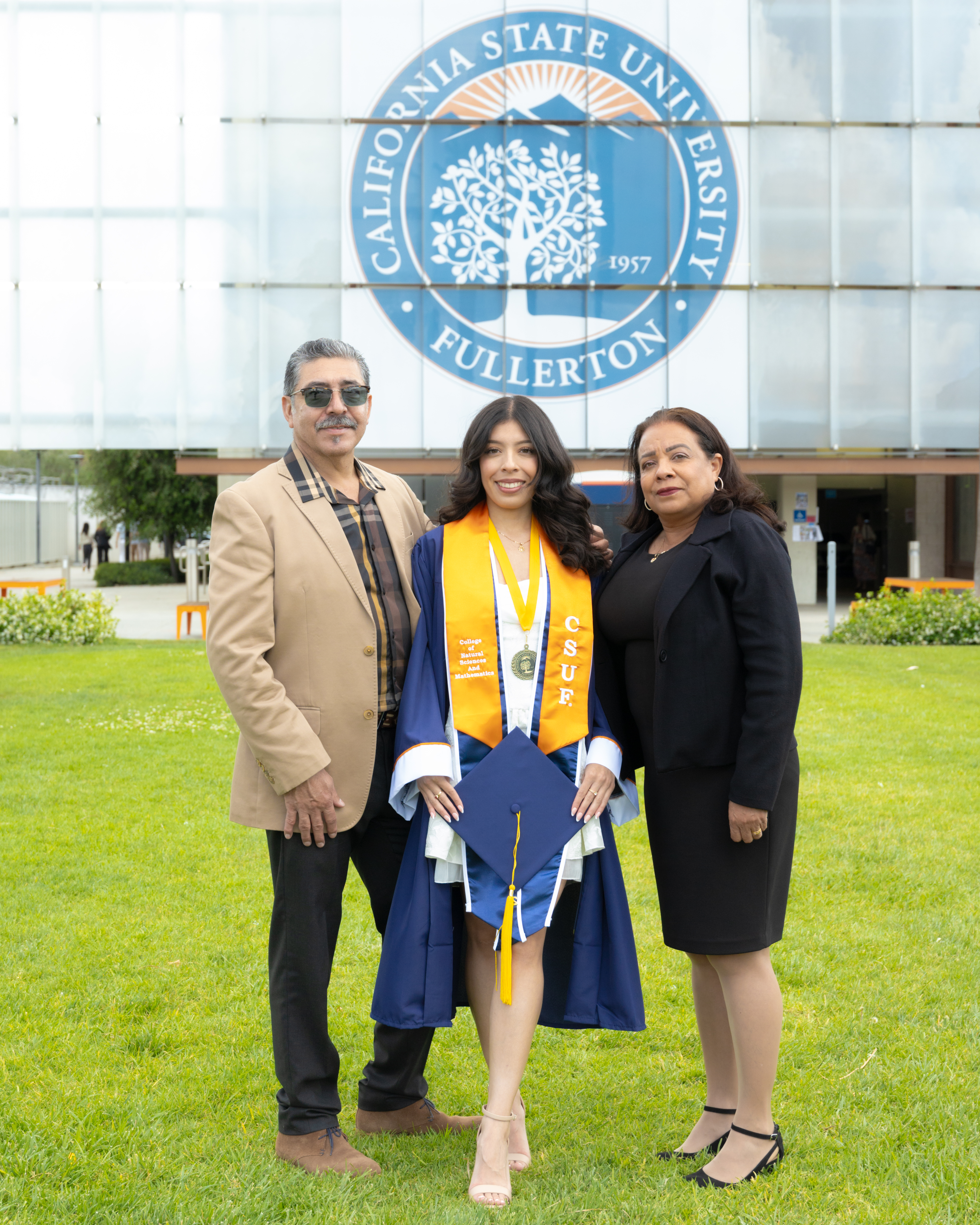
Gisselle Contreras’s parents beam with pride at all she’s achieved.
“I’ve exceeded their expectations,” said Contreras.
Gisselle Contreras’s parents beam with pride at all she’s achieved.

A graduate of California State University, Fullerton, with a degree in molecular biology, she’s the first person in her family to earn a college degree.
She’s researching gene and cell therapies to treat glioblastoma, an aggressive type of brain tumor. Along with being among the most aggressive cancers that originate in the brain, it is also the most common type of brain cancer. Survival rates are not high, and treatment often involves surgery and chemotherapy, but there are several efforts to use gene and cell therapy treatments.
Pathfinding a career in science
Lab work after graduation is also opening a potential career pathway for Contreras. That may involve attending medical school to become a pathologist or cancer researcher. Before participating in the Bridge program, it wasn’t a career path that seemed attainable.
“I think what they had in mind for me was to, you know, get a bachelor’s degree and start working,” said Contreras. “I don’t think my parents expected me to have the drive to pursue a higher education degree after my bachelor’s.”
Her expanded career options in science come largely from a California Institute for Regenerative Medicine–funded program at Cal State Fullerton. At Fullerton, Contreras joined the CIRM‑supported Bridges program run by Nilay Patel, PhD. The program helped her secure her job at City of Hope.
“Training on our campus is one thing, but interning with top‑notch scientists is priceless,” said Patel, an associate professor of biological science. “They gain access to great opportunities and a strong jump‑start on their careers. Contreras is a caring, disciplined, and hard‑working student.”
Bridges to future careers
Before joining Bridges, Contreras tutored high school students—something Patel said aligned well with CIRM’s community outreach.
“We were impressed to see a community‑minded student who was also excited about stem cell biology research,” he said.
Over the last decade, CIRM has invested about $10 million in the Fullerton program for undergraduates in cell and gene therapy, medicine, and the sciences. The program provides seven months of training so students are ready for lab work at places like City of Hope. Statewide, CIRM has trained more than 4,600 students across high school, undergraduate, and postgraduate programs. For many, this training opens career paths they may not have known existed.
CIRM is a unique agency funded by Californians. Its mission is to accelerate cell and gene therapy development from early research to FDA‑facing trials. Training students like Contreras helps build the workforce needed to support the infrastructure that makes California a leader in regenerative medicine. It also opens doors to careers that might not have been available otherwise.
Contreras’ mother works as a home caregiver, and her father is an industrial machinist. They support her, but they don’t fully understand what medical school requires, from preparing for the MCAT to shadowing doctors, earning clinical hours, and ideally joining published research.
“This is all new land for the whole family to explore,” said Contreras, who works 32 hours a week in her research job, has shadowed doctors in the hospital, and has begun preparing for the MCAT.
A first-generation graduate
If she is honest, Contreras said she is surprised by where she is now.
In high school, she was a “band kid” and intimidated by science. At the time, she might have said she wanted to be a veterinarian. Gene and cell therapy, cancer research, or a medical degree felt far beyond her reach.
“Ten years ago, I would have never thought I would be doing cancer research,” she said.
In high school, she joined an after‑school program and learned physics through rocket-building and gravity experiments. That was her first taste of science.
Without family members in college or science, she lacked a mentor who could show her what was possible. Dr. Patel and the Bridges program at Cal State Fullerton opened a new path. He encouraged her and helped her prepare for work at City of Hope.
Finding community in the sciences
At City of Hope, Contreras works under Dr. Karen S. Aboody, a professor in stem cell biology and neurosurgery. Dr. Aboody, who trained as an MD before becoming a principal investigator, mentors Contreras and shows her what is possible in medicine or research.
“Gisselle is very motivated and enthusiastic, learning new skills quickly,” said Dr. Aboody, who first brought her on her research team in 2025 to work on both glioma and ovarian cancer research.
The focus of that work was on optimizing efficacy with a tumor-tropic stem cell line engineered to deliver an oncolytic adenovirus.
“I had so much confidence in her that I sent her to the 2025 Society for Neuro-Oncology annual conference (international attendance), where she was one of the youngest participants to present a poster of our work,” said Dr. Aboody.
Impressed by her work, Dr. Aboody kept Gisselle on as a research associate after Gisselle graduated earlier this year.
“She has tremendous potential, and I encourage her to consider pursuing a PhD,” Dr. Aboody said. “For now, I’m glad to have her helping us move to first-in-human ovarian cancer trials planned for 2027.”
Looking Ahead
Having a mentor has been transformative, but working in the lab has given her something else: a community of fellow scientists and aspiring researchers. A few are also like Contreras, first-generation students paving their own way in the sciences.
“We have that connection,” she says. “We also have parents who don’t speak English, who don’t really understand what research we’re doing.”
They also share the experience of feeling unfamiliar with science and believing they don’t belong.
Contreras remembers how terrified she felt when she started in a research lab two years ago, unsure of her abilities or place. When she was younger, she needed someone to show her what was possible.
Now she reminds herself to “just go for it” when doubts appear.
“My parents just want me to be happy and satisfied with what I do,” she said. “I want to make them proud.”
Contreras wants to help more high school students consider science education. About a year ago, she worked with a nonprofit to connect CIRM staff with the idea of introducing STEM and stem cell research to more students. Through the SPARK program, CIRM has trained almost 1,000 high school students in cell and gene therapy. She believes planting those seeds early can change outcomes for students who might not otherwise know this path exists.
For Contreras, that path might lead to medical school or an advanced science degree. Some programs combine medical training and a PhD. She is not yet sure which direction she will choose, but she knows she wants to continue research that directly helps patients.
“I genuinely feel like I make a difference in people’s lives because of the work that I do here at City of Hope,” she said.